Rain, Circulation & the Question of Waste
Copied
Liger Academy Field Exploration
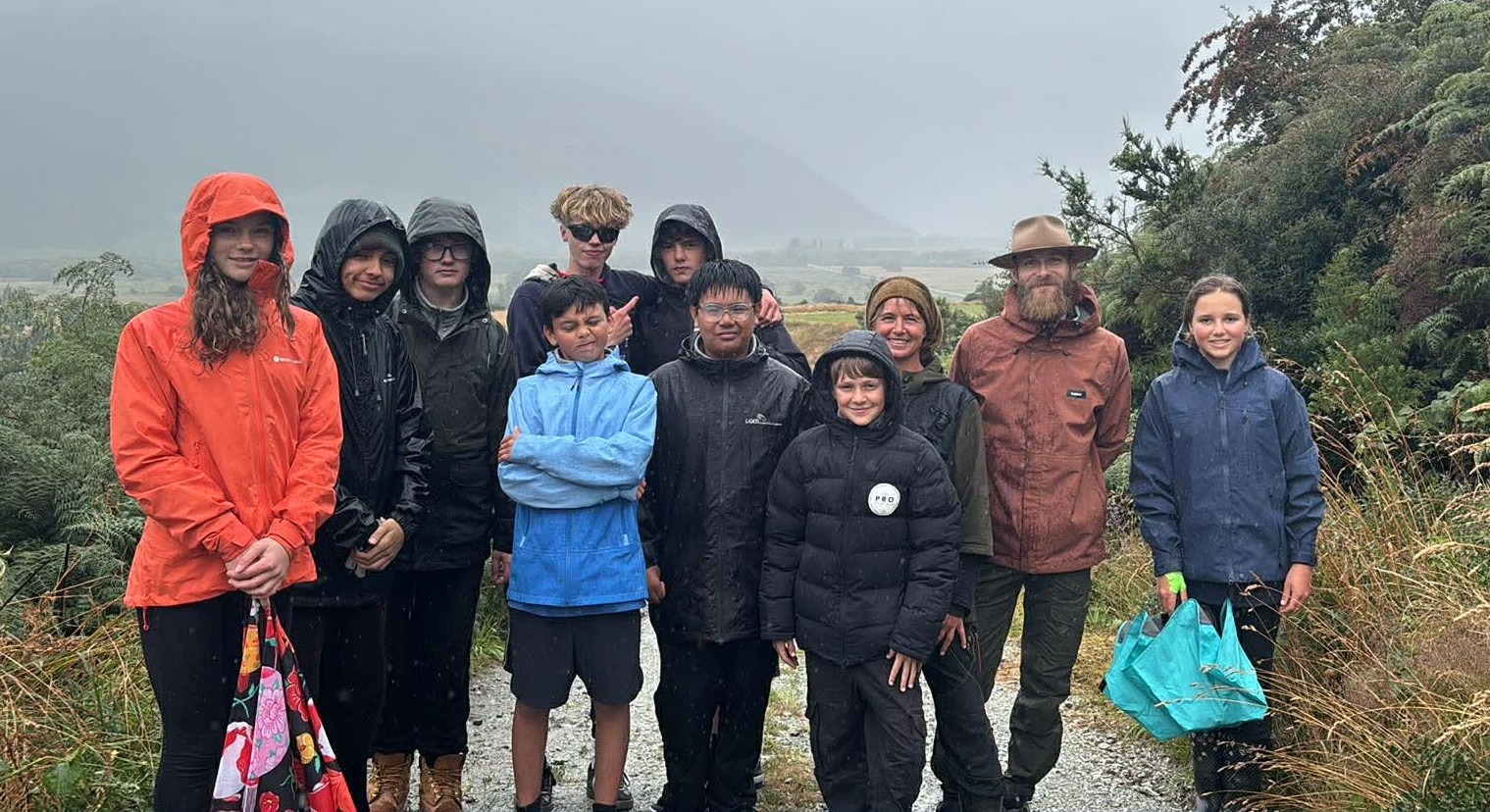
A steady rain welcomed nine students from Liger Academy/ Queenstown to BROOMHILL for their first field exploration on the whenua. The gardens were saturated, leaves glossed with water, and pathways softened into earth. It felt like the right conditions to begin a conversation about circulation — about what moves, what accumulates, and what we call “waste.”
Their current school inquiry is rooted in food circulation, waste output and management, understanding waste behaviour, utilising excess produce, and developing relational solutions.
In our opening circle, curiosity moved easily. What counts as waste? When does surplus become a problem? How can we adjust behavior so less waste is produced? What resources are already available to us, and how can we consciously relate back to what we consume?
The day quickly shifted from conversation into practice. The previously prepared biochar opened a hands-on exploration of how wood — often seen as scrap or offcut — can be transformed into a stable form of carbon that supports long-term soil fertility.
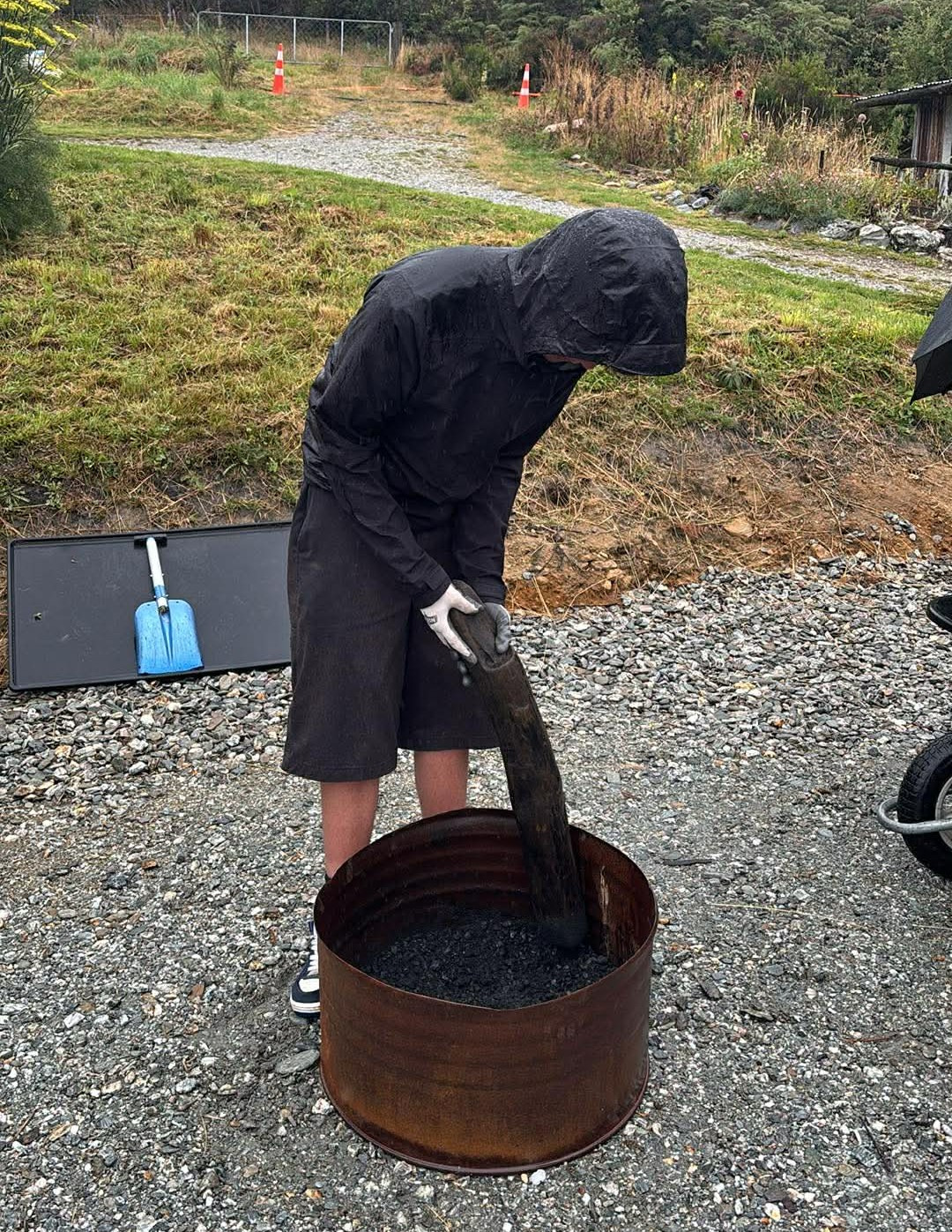
Gathered around the cooled char, the students took turns crushing it, breaking the brittle blackened pieces into smaller, fine-graded fragments. It was slow, physical work. The process required patience and repetition. There was no instant result — only gradual transformation through consistent effort.
In that rhythm of crushing, another layer of understanding surfaced: time input, physical labour, embodied energy. The contrast between making something by hand and purchasing a neatly packaged soil amendment from a shelf became tangible. What knowledge disappears when effort is outsourced? What relationship forms when your own body participates in creating fertility?
Biochar became not just a soil input, but a conversation about value. It reflects relationship. We spoke about inoculation — how raw char must first be charged with nutrients and microbial life before entering the soil system. Even stabilised carbon cannot function alone. It depends on compost, microbes, moisture, and roots. Nothing operates in isolation.
Alongside this, some students harvested tall bracken fern — biomass for future bracken-brick making. Hands busy cutting and bundling, they considered how dominant growth might shift from “overgrowth” to building resource. The physicality mattered: the weight of the bundles, the texture of the stems, the rhythm of coordinated effort. Systems thinking became embodied.
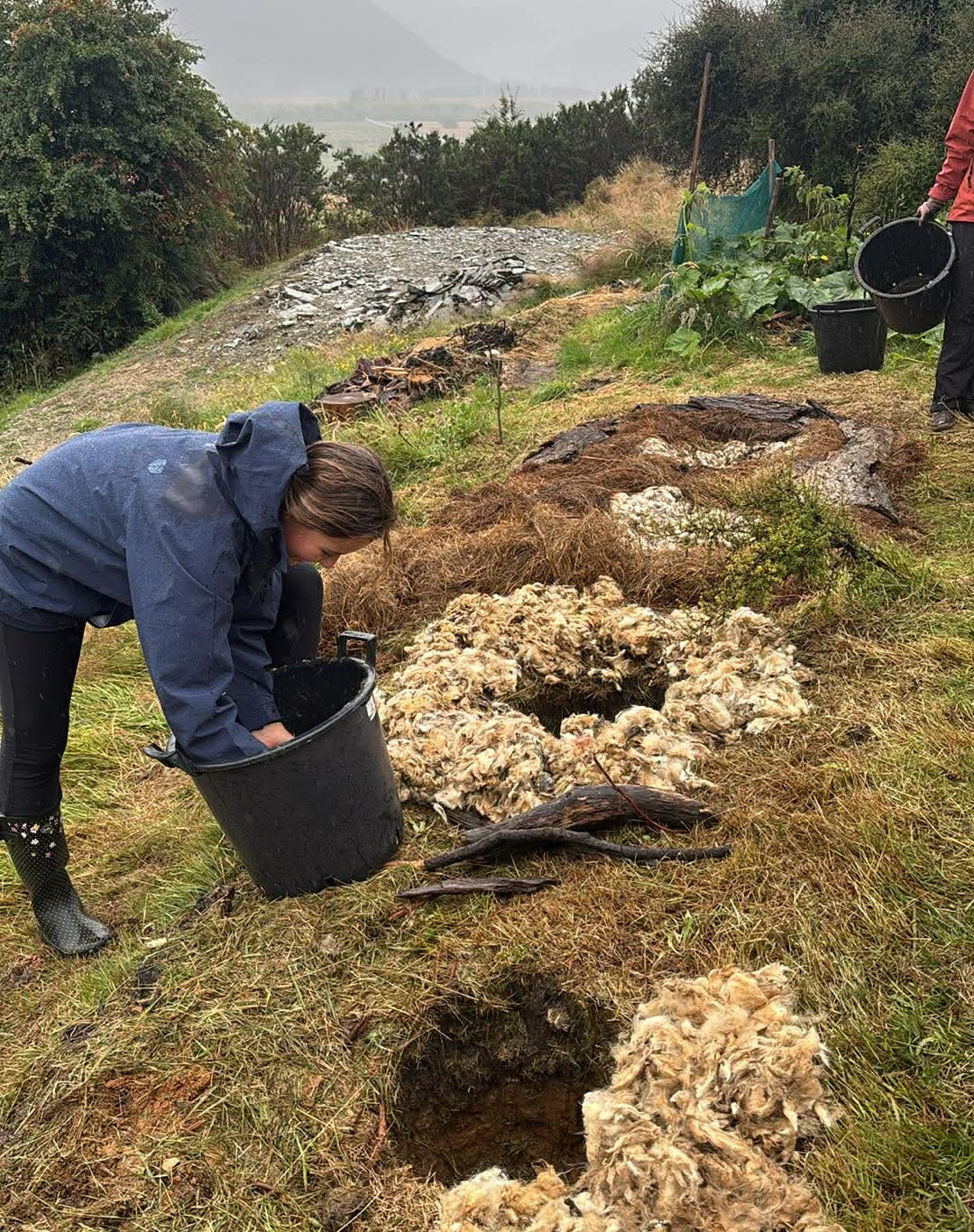
Mulching followed, using regional materials often considered waste by others — sheep dags, rotten baleage, and pine bark — to shape the foundation of an emerging blueberry orchard. The rain amplified the lesson. Moisture behaviour was immediately visible. Different textures responded differently. Coverage altered temperature, retention, and flow. Nothing abstract — everything observable.
Throughout the day, a simple insight kept returning: waste is rarely a thing. More often, it is a relationship not yet designed.
As the hours passed, the rain became secondary. Umbrellas were set aside. Time felt both full and not nearly long enough. Nine students stood within a living system — not separate from it, but participating in it, contributing to it, learning directly from it.
This was not simply a field trip. It was a first engagement with the whenua as teacher — and the beginning of a conversation that will continue well beyond a single rainy day.
The enjoyment was shared by students and teachers alike — a reminder that field-based learning brings theory into touch, thought into action, and questions into lived experience.
A steady rain welcomed nine students from Liger Academy/ Queenstown to BROOMHILL for their first field exploration on the whenua. The gardens were saturated, leaves glossed with water, and pathways softened into earth. It felt like the right conditions to begin a conversation about circulation — about what moves, what accumulates, and what we call “waste.”
Their current school inquiry is rooted in food circulation, waste output and management, understanding waste behaviour, utilising excess produce, and developing relational solutions.
In our opening circle, curiosity moved easily. What counts as waste? When does surplus become a problem? How can we adjust behavior so less waste is produced? What resources are already available to us, and how can we consciously relate back to what we consume?
The day quickly shifted from conversation into practice. The previously prepared biochar opened a hands-on exploration of how wood — often seen as scrap or offcut — can be transformed into a stable form of carbon that supports long-term soil fertility.
Gathered around the cooled char, the students took turns crushing it, breaking the brittle blackened pieces into smaller, fine-graded fragments. It was slow, physical work. The process required patience and repetition. There was no instant result — only gradual transformation through consistent effort.
In that rhythm of crushing, another layer of understanding surfaced: time input, physical labour, embodied energy. The contrast between making something by hand and purchasing a neatly packaged soil amendment from a shelf became tangible. What knowledge disappears when effort is outsourced? What relationship forms when your own body participates in creating fertility?
Biochar became not just a soil input, but a conversation about value. It reflects relationship. We spoke about inoculation — how raw char must first be charged with nutrients and microbial life before entering the soil system. Even stabilised carbon cannot function alone. It depends on compost, microbes, moisture, and roots. Nothing operates in isolation.
Alongside this, some students harvested tall bracken fern — biomass for future bracken-brick making. Hands busy cutting and bundling, they considered how dominant growth might shift from “overgrowth” to building resource. The physicality mattered: the weight of the bundles, the texture of the stems, the rhythm of coordinated effort. Systems thinking became embodied.
Mulching followed, using regional materials often considered waste by others — sheep dags, rotten baleage, and pine bark — to shape the foundation of an emerging blueberry orchard. The rain amplified the lesson. Moisture behaviour was immediately visible. Different textures responded differently. Coverage altered temperature, retention, and flow. Nothing abstract — everything observable.
Throughout the day, a simple insight kept returning: waste is rarely a thing. More often, it is a relationship not yet designed.
As the hours passed, the rain became secondary. Umbrellas were set aside. Time felt both full and not nearly long enough. Nine students stood within a living system — not separate from it, but participating in it, contributing to it, learning directly from it.
This was not simply a field trip. It was a first engagement with the whenua as teacher — and the beginning of a conversation that will continue well beyond a single rainy day.
The enjoyment was shared by students and teachers alike — a reminder that field-based learning brings theory into touch, thought into action, and questions into lived experience.